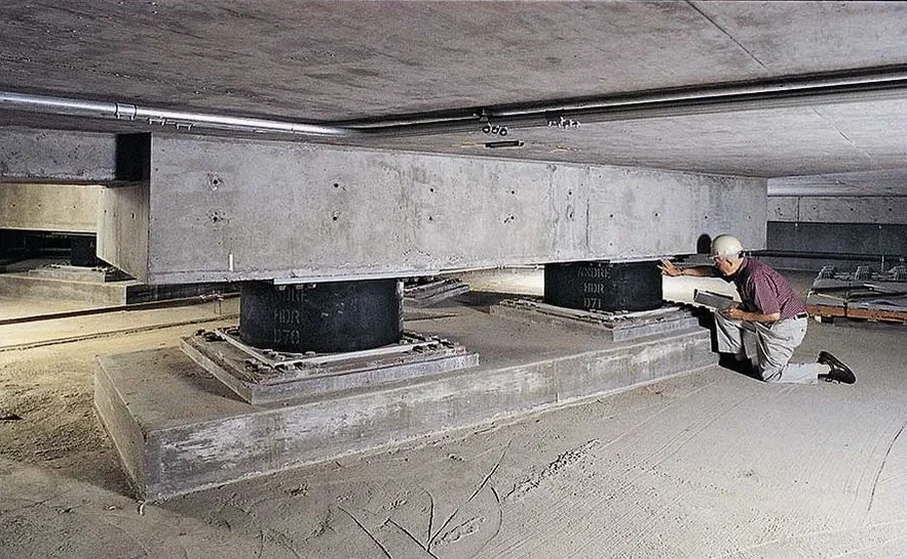
A set of high-damping elastomeric bearings arrives at the yard, still wrapped in protective film. Each unit is tagged for a specific column grid on a Laredo project, designed to decouple the superstructure from ground motion. The bearings are not off-the-shelf items; they are engineered for the site-specific acceleration spectra we developed from local borings. Laredo sits on the Carrizo-Wilcox outcrop and Quaternary alluvium of the Rio Grande floodplain, where stiff clays transition to loose sands within a single city block. Our team handles the full design loop: from the seismic microzonation study that defines the design earthquake, through isolator prototyping, to the deep excavations required for the moat walls that allow the isolated structure to move freely during a seismic event. We coordinate directly with the architect to keep the moat covers flush and the utilities articulated, so the isolation plane does not become a maintenance headache later.
A properly tuned isolation plane can cut seismic forces by 60 to 75 percent compared to a fixed-base structure on Laredo's soft soil sites.