GEOTECHNICAL ENGINEERING
LAREDO
HomeLaboratoryTriaxial test

Triaxial Shear Testing in Laredo for Foundation Design

Knowledgeable. Thorough. Resourceful.

LEARN MORE

The Laredo Formation and the younger Quaternary alluvium that runs under the Rio Grande define the subsurface across Webb County. What we typically encounter beyond the first 3 to 5 meters are interbedded clays and silty sands with occasional caliche layers, materials that demand more than a pocket penetrometer reading when vertical loads exceed 150 kips. A triaxial test on an undisturbed Shelby tube sample gives the effective cohesion and friction angle under the exact confining pressure the stratum will see once the footing is loaded. In our experience running consolidated-undrained tests with pore pressure measurement on Laredo clays, the difference between drained and undrained parameters often decides whether the geotechnical report calls for a mat foundation or can stick with isolated footings. The IBC references ASTM D4767 for this procedure, and it is the standard we follow when the site sits within the 100-year floodplain or near the river’s historic meander scars, where saturation is practically permanent. For deep sand lenses we complement the lab data with a CPT sounding to confirm the in-situ state before triaxial interpretation.

A CU triaxial with pore pressure measurement on Laredo clay reveals the true drained friction angle, often 2 to 4 degrees higher than unconsolidated-undrained estimates would suggest.
Our service areas

Methodology and scope

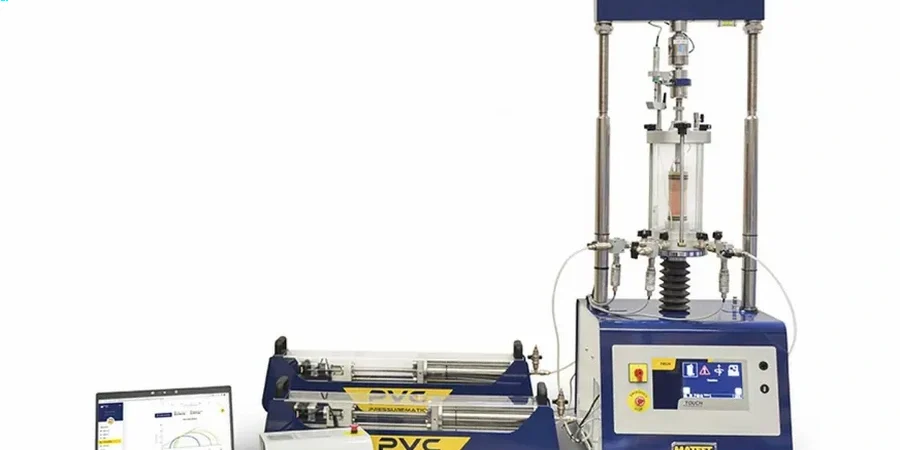
The triaxial cell we configure for Laredo projects is a Bishop & Wesley type mounted on a servo-controlled load frame capable of back-pressure saturation up to 100 psi, which is necessary to get a B-value above 0.95 in the low-plasticity clays of the Laredo Formation. The setup includes three precision pressure-volume controllers that manage cell pressure, back pressure, and axial displacement independently, so we can run a multistage CU test on a single specimen when core recovery is limited. A 2-inch diameter specimen is trimmed inside a humid room that holds at 100 percent relative humidity, then sealed with a latex membrane and two O-rings before filling the chamber with de-aired water. Consolidation follows the in-situ stress history; we often see preconsolidation ratios between 1.8 and 2.5 in the overconsolidated strata north of Highway 359, so the loading schedule accounts for the geological unloading from ancestral terrace erosion. The data acquisition logs deviator stress, excess pore pressure, and axial strain at 1-second intervals, giving us the stress path on a Cambridge p-q diagram that the project structural engineer can take straight into a PLAXIS or Settle3 model.
Triaxial Shear Testing in Laredo for Foundation Design
Technical reference — Laredo

Site-specific factors

Laredo’s growth along the I-35 corridor has pushed commercial pads onto parcels that thirty years ago were ranchland irrigated by floodwater, and the compaction history under those old fields is far from uniform. A structure founded on a stratum where the triaxial test was skipped—relying only on pocket penetrometer or unconfined compression—can experience differential settlement as the silty sand lenses consolidate under the new load. The more dangerous scenario is a bearing failure in a saturated clay lens whose undrained shear strength drops sharply once pore pressure builds during rapid loading. The lab’s CU triaxial with pore pressure measurement catches that drop before the backhoe breaks ground. Downstream of the International Bridge, where warehouses and cold-storage facilities sit on deep Rio Grande alluvium, the combination of static dead load and live-load vibration from truck docks makes drained triaxial parameters essential input for any settlement-sensitive slab. Ignoring the effective stress path in these conditions is a gamble that has cost owners in the region six-figure remedial underpinning work.

Need a geotechnical assessment?

Reply within 24h.

Email: contact@geotechnical-engineering1.org

Regulatory framework

ASTM D4767 - Consolidated Undrained Triaxial Compression Test for Cohesive Soils, ASTM D7181 - Consolidated Drained Triaxial Compression Test for Soils, IBC Chapter 18 - Soils and Foundations, ASCE 7 Minimum Design Loads and Associated Criteria for Buildings and Other Structures

Typical values

ParameterTypical value
Specimen diameter1.4 to 2.8 in (35 to 71 mm)
Maximum cell pressure1,500 psi (10.3 MPa)
Back-pressure saturation B-value≥ 0.95
Strain rate for CU on CH clay0.003 to 0.01 in/min
Pore pressure transducer accuracy± 0.1 psi
Consolidation ratio typical in Laredo FormationOCR 1.8 to 2.5
Data scan rate during shear1 Hz

Common questions

What is the standard turnaround time for a triaxial test in Laredo?

A standard consolidated-undrained triaxial with pore pressure measurement on one specimen takes five to seven working days from sample extrusion to final report. If the project requires three effective confining pressures for a full Mohr-Coulomb envelope, expect seven to ten working days. We can expedite the shearing phase for an additional fee when the drilling crew is still on site and the project schedule is tight.

How much does a triaxial test program cost?

A three-point CU triaxial program on Laredo clay, including consolidation, shear, and the signed engineering report with stress path plots, runs between US$1,680 and US$2,720 depending on the number of specimens and whether drained or multistage protocols are required. We quote per project after reviewing the borehole logs and sample quality.

Do you need a drill rig to collect the triaxial sample?

Yes, the triaxial specimen must be an undisturbed sample obtained with a thin-walled Shelby tube pushed by a drill rig. The tube diameter is typically 3 inches, and the sample must be sealed with wax immediately at the borehole to preserve the in-situ moisture. We coordinate with a local drilling contractor in Laredo that knows the refusal depths in the caliche layers.

Can a triaxial test be run on sand or gravel from Laredo alluvium?

Triaxial testing on sand is possible but requires a reconstituted specimen prepared to the field density and moisture, since undisturbed sampling of clean sand is nearly impossible. We use the moist tamping method and saturate the specimen with back pressure. For gravelly soils with particles larger than 1/3 of the specimen diameter, we recommend a large-scale triaxial or an alternative approach like the CPT test to derive friction angle from cone resistance correlations.

Which drainage condition should I specify for a foundation on Laredo clay?

For most building foundations on the medium to high-plasticity clays of the Laredo Formation, we recommend the consolidated-undrained test with pore pressure measurement. The construction loading rate is fast enough that the clay behaves undrained during the critical first months, so the undrained shear strength governs bearing capacity, but the effective stress parameters from the same test are needed for long-term settlement. For permanent retaining walls or slopes above the river terraces, add a drained test to capture the frictional behavior once excess pore pressure has dissipated.

Location and service area

We serve projects in Laredo and surrounding areas.

View larger map